
Most business owners I talk to have a gut feeling their marketing isn’t producing what it should. They’re not sure what’s wrong, exactly. They just know they’ve been paying for it for a while and the phone isn’t ringing any more than it was before.
The honest answer to “is my marketing working?” is usually one of two things: either yes, here’s the evidence, or we don’t have the data to know. The second answer is far more common than business owners realize — and it means the problem isn’t the marketing itself. It’s that nobody set up the system to measure it.
An audit is how you find out which situation you’re in. And the one at github.com/FrankCJones/optsus-skills is free.
What a marketing audit actually looks at
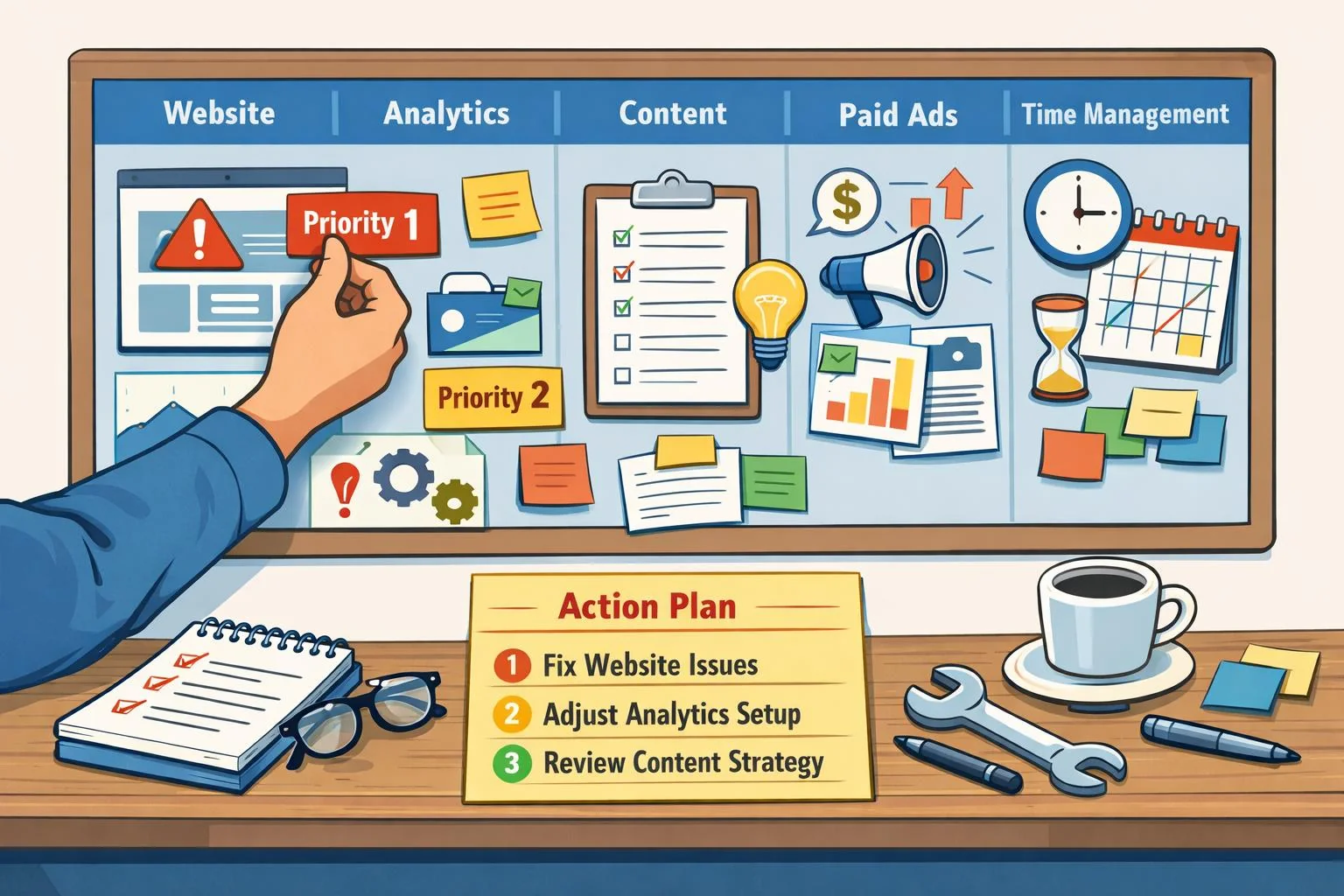
A real marketing audit isn’t a quiz that gives you a score and sends you a report card. It’s a structured review of five areas that together determine whether your marketing is capable of producing measurable results.
The five areas are your website, your measurement and tracking setup, your content, your paid channels, and your time — meaning how much of it you’re spending on marketing versus how much you have available.
Most businesses have something going on in all five areas. The audit doesn’t grade you on how much you have — it surfaces the specific gaps that are keeping things from connecting. A business can have a great website and active social media and still have no way to tell whether any of it is producing leads, because the measurement layer was never built.
That gap is usually what the audit finds.
What the audit found for a real estate agent
A real estate agent came to me after a marketing conference where other agents were raving about ads and chatbots. She wanted both — she’d heard they were producing leads for other people in her market and figured she was behind.
Before I agreed to build anything, I asked her one question: how many leads did she get from her website last month?
She didn’t know. She had no way to know — there was no tracking on the site, no form submission data, nothing that connected a website visit to a lead. Which meant that if I ran ads that sent traffic to her site, we’d have no way to tell whether any of those visitors had ever become a client.
I sold her on tracking first. After one month, we had data — not perfect data, but real data. And what it showed stopped the campaign conversation entirely.
A hundred percent of her mobile visitors were bouncing from the site. It was slow enough that people wouldn’t wait for it to load, and the menu took up two full rows on a desktop screen, which made it nearly impossible to navigate on a phone. Mobile accounts for about 60% of web traffic. Running ads that sent people to a site that immediately drove them away would have been a reliable way to waste money.
We redesigned the site instead of running ads. Made it mobile-responsive. Simplified the navigation. The data also showed that people visited three specific pages before submitting a lead form, so we moved those three pages to the top of the menu and put everything else in sub-menus.
The following month, leads doubled — with no ads and no chatbot.
She came in thinking she had a marketing problem. She had a foundation problem. The audit is how we found it.
What the audit tells you that you can’t see without it
The real estate agent example is not unusual. The pattern — business owner wants more of something, assumes the answer is more spending, turns out the system was broken and nobody had the data to see it — is the most common thing I encounter in new client conversations.
The audit doesn’t assume you have a specific problem. It looks at what you actually have, asks about what you’re doing, and finds the places where the chain breaks. Sometimes it finds a broken measurement setup. Sometimes it finds a website that’s working against the marketing. Sometimes it finds that everything is fine and the problem is something else entirely.
The goal isn’t to find things to criticize. It’s to get a clear picture of where things stand so you can prioritize what to work on first.
How to run your own marketing audit
The OSM Audit walks through all five areas in one session. It asks open-ended questions about what you have and how things work, and at the end it produces a prioritized list of what to address first and a plain-language explanation of what each gap is costing you.
It’s free. It takes one sitting. And it tells you what your marketing actually looks like, not what you hope it looks like.
For current website and content service options, see the OSM service.