
If you have published a blog post or recorded a YouTube video in the last six months, you have more social media content than you realize. You just haven’t turned it into posts yet.
Most business owners think about content creation as a linear process. Write a blog post. Post it. Move on to the next one. Meanwhile, the social accounts need feeding every day, which feels like a completely separate job — one that requires starting from scratch every time.
It doesn’t. One blog post or video contains enough material for weeks of social content. The question is whether you extract it or leave it sitting there.
Why social posting feels like a treadmill
The default approach to social media for most businesses is to wake up, realize something needs to go out today, and write something. Or hire someone to write something. Or skip it.
This produces either frantic last-minute posts that lack substance, generic filler that says nothing specific, or long stretches of silence. None of these build an audience. None of them reinforce what you actually know and believe.
The problem isn’t effort. It’s that content is being created twice — once in the actual work (the blog, the video, the expertise that went into it) and then again from scratch for social. The first creation is where the real thinking happened. The second creation is just labor.
What’s actually inside a piece of content
A 1,000-word blog post contains more than you probably think. There’s the core argument — the one thing you want the reader to take away. There are the supporting points that build the case. There’s a story or example that makes it concrete. There’s the framing you use to explain the problem, which is different from the framing a competitor would use. There may be a surprising fact, a counterintuitive observation, or a direct challenge to the conventional wisdom in your industry.
Each of those is a social post.
The story can be told in three sentences with a hook. The counterintuitive observation can stand alone as a one-liner. The supporting argument can become a thread or a short video clip. The conventional wisdom you’re pushing back on can become a question you put to your audience.
A single well-constructed blog post, pulled apart and reconstructed for social formats, can produce 10 to 20 distinct posts before it’s exhausted. A YouTube video can produce more.
The alternative to writing social content every day
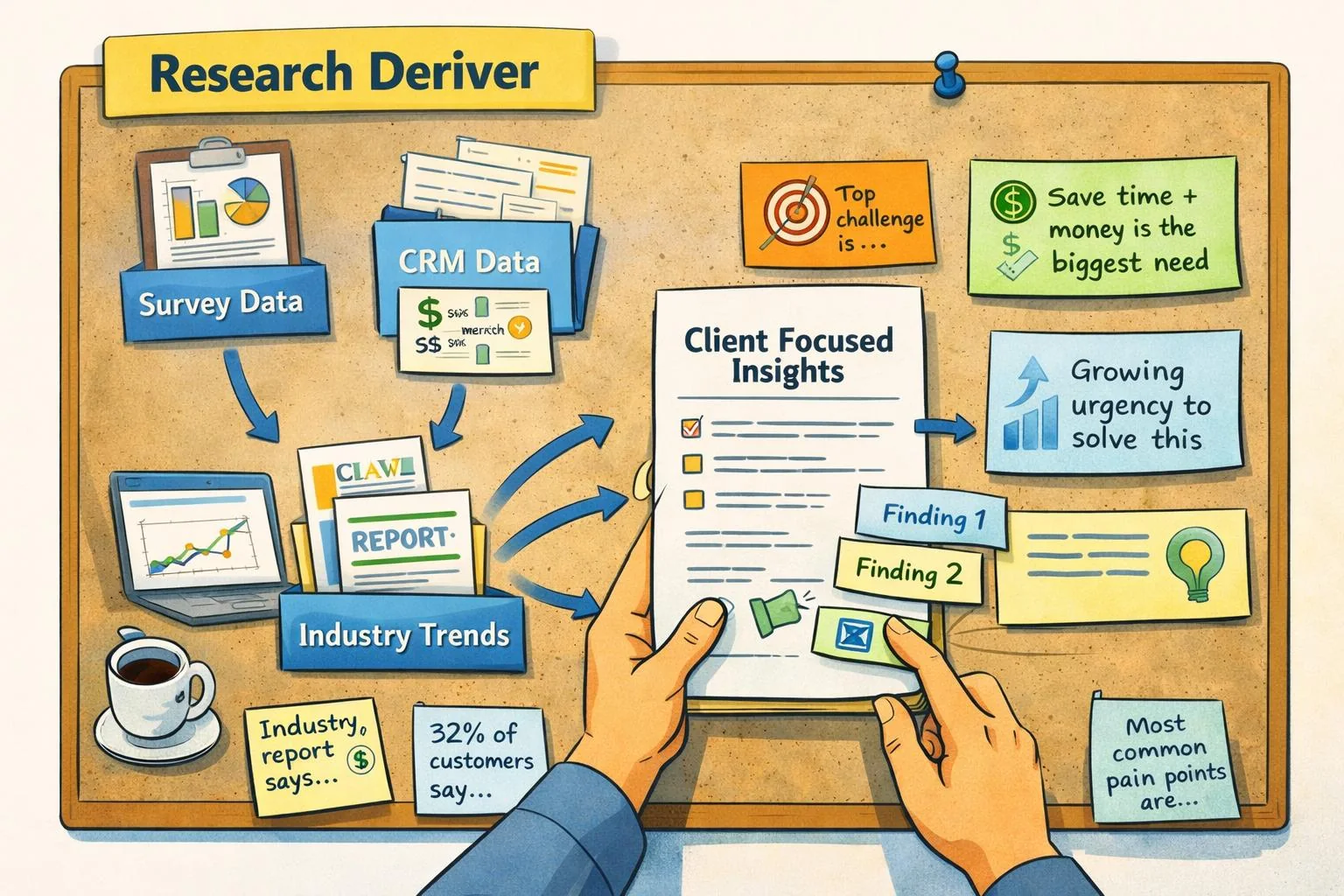
The Social Post Deriver takes a published piece — a blog post URL, a YouTube video, or a page on your site — and extracts that content systematically. It identifies the core arguments, the stories, the specific details, the opinion moments, the practical advice, and the questions worth asking.
From those elements, it builds a batch of social posts formatted for scheduling. Each post is labeled by type (story, observation, question, tip, hook, quote, etc.) and platform, with a brief note on timing recommendations where relevant.
The output is a CSV you can load into any scheduling tool or paste directly into your posting workflow. A hundred posts from a handful of pieces of content. The work of several months of daily posting, done in one session.
That changes the math on content creation. Instead of social posting being a daily demand, it becomes a batch task you do after publishing — a natural extension of the work you already did, not a separate job on top of it.
What this does for your marketing over time
Consistency in social media produces compounding results: more reach, more followers, more inbound. But consistency only happens when the process is sustainable. Most businesses fail at social consistency not because they lack content — they lack a system for turning the content they have into posts.
The Social Post Deriver is that system. Free, one session per content piece, and it turns something you’ve already done into months of material.
For current website and content service options, see the OSM service.